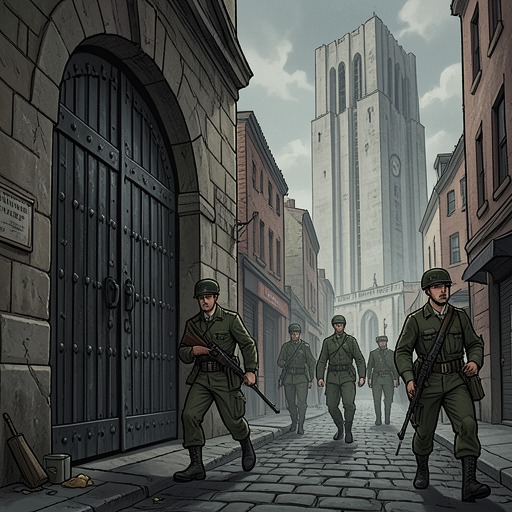
March on Fiume
M: Son of the CenturyThe March on Fiume was Gabriele D’Annunzio’s seizure of the city with his legionnaires in 1919. In the book’s account, it became more than a territorial fait accompli: D’Annunzio cast Fiume as a living alternative to the exhausted diplomacy of the postwar settlement, while its eventual isolation and demobilization exposed the gap between revolutionary performance and the support needed to sustain it.
Postwar setting and the meaning of Fiume
The seizure unfolded amid the return of millions of soldiers to a country still shaped by war. The narrator depicts Europe as a stage emptied of its old political actors, with five million Italian veterans pressing back across the borders and the prospect of further conflict still present. That atmosphere helps explain why Fiume could be imagined not simply as a disputed possession but as a place where the postwar order might be remade.
D’Annunzio gave that claim a dramatic contrast. Speaking to his legionnaires on the first day of 1920, he presented 1919 as the year of Fiume rather than the year of the Versailles negotiations. In his account, Versailles stood for a faltering Europe of suspicion and bargaining; Fiume, by contrast, signified youth, life, heroic action, and a future carried forward by the dead and the unborn. The march’s political force thus rested partly on its ability to turn a territorial occupation into a story of national renewal.
That story did not represent a settled consensus in the city itself. D’Annunzio chose to remain in Fiume against the wishes of the Fiumani, and the narrator punctures the grandeur of his rhetoric by observing that Italians did not follow him as he expected. Fiume could be proclaimed a freer and more vital place, yet its leader’s hold on it depended on choices that were increasingly difficult to reconcile with the people he claimed to embody.
Attempts to widen the revolt
The possibility of extending the Fiume enterprise into a wider uprising came into view during discussions with Alceste De Ambris. De Ambris argued that rebellion remained possible and outlined a route from Fiume toward Rome: naval vessels could carry troops to Zadar and onward to Ancona, where a regiment had rebelled the previous July. He proposed making arrangements with fascists in the Marches and relied on the continuing friendship of Captain Giulietti’s seamen. These were plans, not actions shown as completed in the account.
Benito Mussolini rejected the premise that such a revolt could succeed. He pointed to the strength of the northern socialist movement and to the fighting in Bologna, insisting that the political situation there made a march on Rome untenable. The exchange revealed a strategic divide: De Ambris treated Fiume as a potential starting point for a popular revolution, while Mussolini was concentrating on the balance of power within Italy and refused to commit the Milan fascists to D’Annunzio’s cause.
Mussolini’s distance was also expressed through policy. Through prefect Lusignoli, he conveyed to Giovanni Giolitti that the government had a clear path to repress the Fiume legionnaires if necessary, while the fascists of Milan would not intervene. In this account, the movement’s later political calculations outweighed solidarity with the occupation. D’Annunzio’s spectacle could command attention without securing the support of the forces that might have helped it spread.
Isolation and demobilization
The occupation’s diminishing prospects were reflected in a long list of departures. Maffeo Pantaleoni urged D’Annunzio to desist; Admiral Millo reaffirmed his loyalty to the king and broke with him; and General Ceccherini and Colonel Siani left, objecting to the legionnaires’ lack of discipline. D’Annunzio refused to surrender absolute power, describing its retention as the one pleasure left amid his boredom. The episode exposes the tension between the occupation’s language of collective liberation and the concentration of authority in its commander.
The confrontation ended under pressure rather than in the triumphant expansion De Ambris had imagined. During the final week of fighting, bombing continued in Fiume, killing one civilian and wounding several others. On December 28, General Ferrario refused to negotiate terms for the legionnaires’ surrender and threatened heavier bombardment; citizen representatives urged D’Annunzio to yield. He handed the powers conferred on him in September to the mayor and the people of Fiume. The narrator adds a telling qualification: through the week of fighting, D’Annunzio had hardly left his study and had not joined his legionnaires on the firing line.
On December 31, an agreement was signed at Abbazia for the legionnaires’ total demobilization from the city. The ending reversed the image of Fiume as a launch point for a new political future: its armed force was to be dismantled, and the city’s immediate fate no longer rested with D’Annunzio’s command. Yet the event’s symbolic life outlasted the occupation. In the book’s telling, Fiume remained a stage on which war, sacrifice, national renewal, and political authority could be made to appear as one—and on which the limits of that performance became visible when its promised allies failed to arrive.